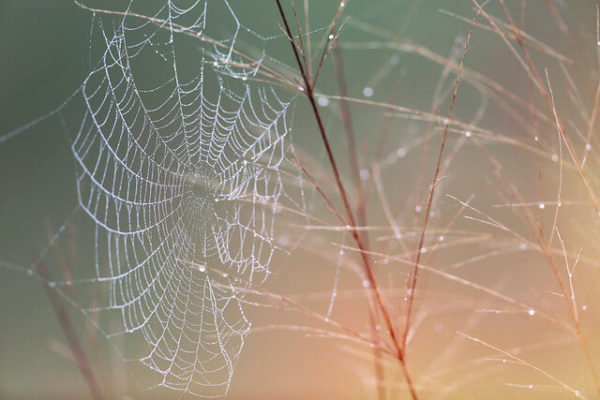
Classic spiral spider webs are made by orb-weaving spiders which weave them deadly traps for flying insects. But orb spider webs are also electrostatically charged, making them perfect for capturing not only prey but pollen and other small pollutants, indicators of an environment’s health.
The webs are made of long strands of intertwined silk, and the compounds in the silk attract water molecules that will coat the entire web. It is this water that establishes a charge. The web then attracts any charged objects that come close to it. Many insects pick up a charge by flying through the air, just as your body becomes charged when you shuffle across the carpet in your socks. So when an insect flies near a spider web, the stretchy, flexible silk strands will actually bend towards the insect and catch it. Depending on the size and charge of the prey, the web can move up to two millimeters toward it. Two millimeters is a huge distance compared to the thickness of the silk, which, on average, is ten times smaller. Listen to learn more of the science of webs…
This Field Note was written by Taylor Craig. Would you be interested in writing one? Contact Allison De Jong, Field Notes editor, at adejong [at] montananaturalist [dot] org or 406.327.0405. Please visit the Field Notes website at the Montana Natural History Center for more information.
or Download